Little Bill Faulconer
The GuiltyLittle Bill Faulconer is Billy Faulconer’s son, a young man presented through brief but telling encounters as intelligent, self-possessed, and closely bound to his father’s fate. His questions about Sherman Clancy’s death and Billy’s arrest bring the murder investigation into the Faulconer family’s immediate orbit; later, his place among people offering condolences gives one of the story’s scenes of loss a note of possible communal change.
Identity and First Encounters
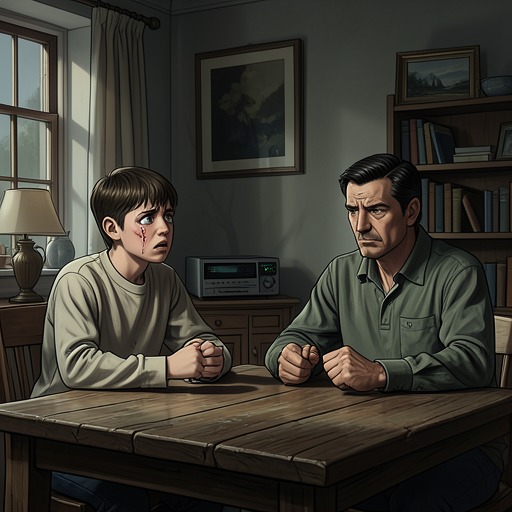
Little Bill enters the narrative in relation to Will Robie and the arrest of his father. He wants to know what Robie has learned about Sherman Clancy’s death and why Billy has been arrested for the murder. The question is direct and practical: rather than treating the arrest as distant town news, Little Bill seeks information from the person investigating the case. His concern establishes him as someone who is paying attention to the danger surrounding his family, though the available scenes do not disclose what conclusions he reaches.
In another encounter, Little Bill sits across the aisle from Robie and motions him over. The gesture makes him an initiator of contact, not merely a figure waiting to be introduced. Robie later tells Billy that he has met Little Bill and calls him a nice young man, adding that Billy has evidently raised him well. The exchange offers an external impression of Little Bill while also reflecting on the father who is separated from him by the murder case.
Family and Ability
Billy’s account of his son emphasizes a particular, concrete competence: Little Bill is good with computers. Billy describes him as knowing computers exceptionally well, while admitting that he himself does not even know how to turn one on. The contrast is affectionate and lightly comic, but it also marks a difference between father and son: Billy recognizes an ability he cannot share or explain. The text supplies no detailed account of Little Bill’s technical work, so his expertise remains a defining capability rather than a developed subplot.
Billy’s concern for his son’s future appears in his discussion of life insurance. He says that he has taken out a policy and paid the premiums in full so the insurer cannot deny the benefit, intending the money to help Little Bill and Angie. He describes the two as people who will be all right with that support. The policy makes Billy’s paternal concern material: the provision is not abstract affection but a financial measure meant to endure beyond his own ability to care for them. The passage does not specify Little Bill’s response to this arrangement, but places his security among the responsibilities occupying his father’s thoughts.
Bereavement and Community
Later, Robie and Jessica Reel return to the Willows and find Little Bill waiting on the porch. The narrative then places him among a crowd, accepting condolences. Many of the white people present are young, a detail Robie notices as he surveys the gathering. Little Bill is at its center, receiving their expressions of sympathy rather than standing apart from the group.
The scene makes his public presence significant without giving him a speech or a new plan. He is both the recipient of other people’s condolences and the visible point around whom they gather. Robie’s thought that there may be hope arises from the composition of the crowd: young white people have come to offer sympathy. Little Bill’s grief therefore intersects with a broader possibility of connection across the town’s racial divisions, although the moment does not establish that those divisions have been overcome.
Narrative Role
Little Bill’s role is defined by a sequence of closely observed gestures and practical details: asking Robie about his father’s arrest, beckoning him across an aisle, being praised by Billy for his computer ability, and accepting condolences among a crowd. The story gives him limited independent action, but these scenes keep the investigation from becoming only a contest among investigators and suspects. The consequences of the case reach a son who wants answers and whose father is already planning for his future.
His computer skill also provides a quiet counterpoint to Billy’s uncertainty about technology, while the insurance policy reverses their usual relationship of care: Billy attempts to protect Little Bill by preparing for a time when he may no longer be able to do so. At the end of the evidence available for Little Bill’s arc, he remains in the community’s view, absorbing its sympathy. The hope Robie senses belongs to the surrounding crowd and to the possibility it represents; the text leaves Little Bill’s own longer-term course unstated.